 Fighting Addiction TogetherWe Do Recover
Is 7-OH banned? Not yet. Here is what actually happened.
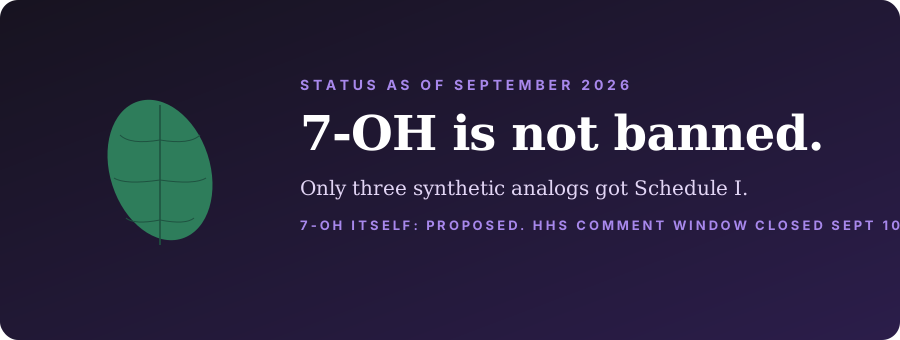
No, not yet. Something did get banned on August 26. It was not 7-OH. If you take these every day, the difference matters a lot more to you than it does to anyone writing about it.
Where it stands today
- 7-OH itself
- Not scheduled. Proposed only.
- Scheduled on 26 Aug 2026
- Three lab made analogs. Not 7-OH, not leaf.
- Public comment
- Closed 10 September 2026. No final order published as of 18 September 2026.
- Legal to sell?
- Unscheduled, but the FDA calls it an unapproved new drug.
What actually happened on August 26
The DEA put three substances into Schedule I on a temporary two year order that runs to 26 August 2028. They are mitragynine pseudoindoxyl, MGM 15 and MGM 16. All three are made in a lab. The order says so in its own words, that unlike mitragynine and 7 hydroxymitragynine which occur in the plant, these three are produced through synthetic modification.
7-OH was not in that order.
You would not know that from the coverage. A television station ran a story on August 27 saying flatly that the DEA had made 7-OH illegal to sell or possess two days earlier. That is wrong on the substance and wrong on the date. It has been repeated all over the place since, which is how half the people reading this ended up believing something that is not true.
What is actually proposed
Back on 6 July 2026 the DEA published a notice of intent to temporarily schedule 7-OH above a set threshold. A notice of intent is not a ban. It is the paperwork that comes before one. That threshold is more than 0.050 percent 7-OH by dry weight for plant material, or for anything else, more than 0.050 percent or more than 1.00 milligram in the article.
Read that threshold carefully, because the shorthand version going around is wrong. Kratom leaf is not carved out by name. It is covered by the same sentence as everything else and it escapes only if it tests under the line. The DEA has said publicly it is not going after leaf. That is a statement about how they intend to use their discretion. It is not what the text says.
Separately, HHS has a request for information open on that threshold. It was supposed to close on 31 July. It got extended to 10 September 2026 and it has now closed. More than thirty two thousand comments had already come in before the extension. As of 18 September 2026 no final order on 7-OH has been published in the Federal Register. Worth knowing what the question actually is: HHS is asking whether the threshold is set at the right number. It is not asking whether any of this should happen.
Nobody can tell you the date. The head of one kratom trade group guessed a month at the earliest, and he was guessing.
Where the FDA already stands
Unscheduled does not mean legal. The FDA has treated concentrated 7-OH as an unapproved new drug since 2025. It sent warning letters to seven companies in June 2025. In July 2025 it formally recommended scheduling and the commissioner said in plain language that 7-OH is an opioid that can be more potent than morphine. In December 2025 the FDA seized roughly seventy three thousand units of product from three Missouri firms with the help of the Justice Department and the US Marshals.
Nine states already prohibit it outright: Alabama, Arkansas, Florida, Indiana, Kentucky, Louisiana, Ohio, Vermont and Wisconsin. Several more cap the concentration. Those lists move and I am not going to pretend the effective dates are all verified.
Now the part that is actually about you
Everything above is a story about agencies. Here is the part almost nobody writes, because almost everyone writing about 7-OH is writing for the industry or against it, and not for the person taking it.
If you are on these every day and the thought of stopping makes your stomach drop, you are not weak and you are not imagining it. You are physically dependent on an opioid you bought at a gas station.
Poison centers logged 901 7-OH exposures in the first six months of 2026 against 593 in all of 2025. Their own advisory lists dependence and withdrawal syndromes among the effects. Published case reports since 2025 include a man who needed inpatient buprenorphine to get through withdrawal, and another whose withdrawal ran to agitation, psychosis and a ventilator.
Be careful with the big kratom numbers you see quoted. The CDC report showing a roughly twelve hundred percent rise in kratom calls over ten years says in its own limitations that the authors could not separate ordinary leaf from concentrated 7-OH products. Anyone waving that figure at you as a 7-OH statistic is stretching it.
There is no taper schedule, and I am not going to invent one
I looked for one. It does not exist. There is no published, validated taper for concentrated 7-OH. There is no conversion telling a doctor how your daily milligrams compare to morphine or to buprenorphine. There is no established withdrawal timeline, and nobody has confirmed that the standard withdrawal scoring sheet clinicians use is even calibrated for this. What exists is a handful of case reports and one small retrospective series, all of them pointing at buprenorphine as the thing that works.
So the honest answer is that this is a doctor's job, not a message board's, and the doctor is an addiction medicine clinician or anyone who can prescribe buprenorphine.
The one thing you have to say out loud
Tell whoever is treating you that you take 7-OH. Say the brand, say the milligrams, say how many times a day.
7-OH is a mu opioid agonist. Buprenorphine kicks other opioids off that receptor. Start it too early and you get precipitated withdrawal, which is not ordinary withdrawal, it is sudden and it is savage, and there is already a published case of it happening to somebody on 7-OH who then left the hospital against medical advice.
Here is the trap. Most prescribers will not recognise a gas station brand name as an opioid. If you say you take a kratom supplement, some of them will hear a herbal tea. Undisclosed use is how people end up in precipitated withdrawal, and it is completely avoidable by naming it. There is no standard induction timing for 7-OH, so this has to be supervised.
What I actually think about the ban
I do have an opinion on this one. Kratom leaf itself is a separate question and I do not have one there. But 7-OH should be banned. It is an extremely addictive and powerful substance and it is not easy to come off of. I have watched people use it to get off far worse things, and I have watched people end up just as stuck on it. Both are true, and neither one changes how hard it is to put down.
The other thing I keep coming back to is the timing. If this gets scheduled, a lot of people who are physically dependent are going to find out when the shelf is empty. There is no taper protocol waiting for them, no outreach, and nothing budgeted. We are going to do the enforcement and skip the part where anybody helps the people it lands on.
If you are one of them, do not wait for the shelf to be empty. Get in front of it now, while you still have the option of doing it on purpose. There are ways to come off it safely, and there are medications that make it a lot more comfortable. If you are struggling with it right now, please reach out. Message or call and talk to somebody who has been there.
Sources
Federal Register, temporary placement of mitragynine pseudoindoxyl, MGM 15 and MGM 16 in Schedule I, docket DEA 1644, published 26 August 2026: federalregister.gov
Federal Register, notice of intent on 7 hydroxymitragynine above a specified threshold, docket DEA 1570, published 6 July 2026: federalregister.gov
HHS request for information, docket HHS OASH 2026 0232, comment period extended to 10 September 2026: public-inspection.federalregister.gov
DEA press release announcing both notices, 1 July 2026: dea.gov
FDA warning letter to a 7-OH retailer, 25 June 2025: fda.gov
HHS on the FDA scheduling recommendation, 29 July 2025: hhs.gov
America's Poison Centers health advisory on 7-OH exposures, 8 July 2026: poisoncenters.org
CDC MMWR on kratom related poison center reports, 26 March 2026, including the limitation that leaf and concentrate could not be separated: cdc.gov
Case report describing withdrawal and precipitated withdrawal after buprenorphine initiation, Cureus, 3 December 2025: cureus.com
University of Michigan Health Lab on 7-OH and treatment options, 25 August 2026: michiganmedicine.org
If any of this is your life right now
Leave your name and a number and somebody who has been through it calls you back, usually within a few minutes. Nothing to sell, nothing to sign.