 Fighting Addiction TogetherWe Do Recover
Fifty eight billion dollars, and nobody was there when I got out.
I wrote the 7-OH piece first and it left me with a question I could not put down. We can move on a molecule in eight weeks. Why can we not move on the part that actually keeps people alive?
Start with the thing that made me angry
On 1 July the DEA published its notice. On 26 August the order was signed and three substances were in Schedule I. Call it eight weeks from paperwork to law.
Now hold that next to the grant that actually pays for treatment in your state. The federal block grant that funds substance use treatment came in at roughly two billion dollars for 2026, an increase of five to twenty million depending on which chamber you read. On a two billion dollar program that is under one percent. Against any honest measure of medical inflation it is a cut with a press release attached.
Eight weeks to schedule a compound. Two years running to not fund the thing that treats the people taking it.
I want to be careful here, because the cheap version of this argument is wrong and I am not going to make it. Scheduling a substance costs almost nothing. It is paperwork. So this is not money going to enforcement instead of treatment. It is attention going one place and not the other. Speed is a choice, and we only ever seem to find it for the banning.
The number that sounds enormous
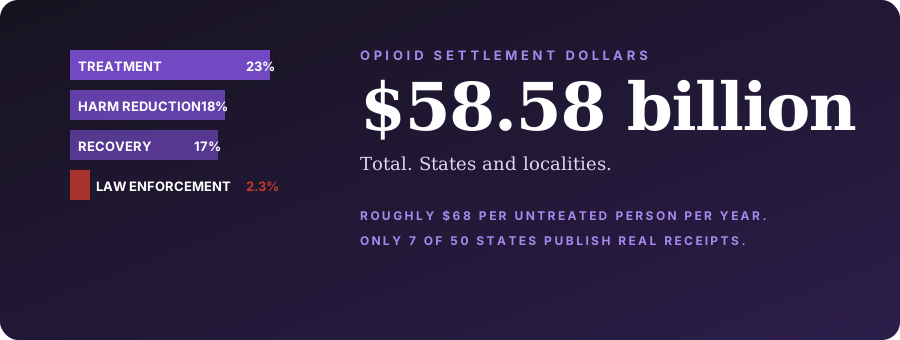
The opioid settlements total 58.58 billion dollars as of April 2026. If you have seen the fifty billion figure quoted everywhere, that number is from 2023 and it is about nine billion short. The money is not sitting in an account. It arrives in instalments through 2038, it is front loaded for some defendants and thin at the back, and nobody indexed a penny of it to inflation. A 2038 dollar will buy considerably less than a 2022 one.
At least 85 percent of it has to go to abatement. Absent a state agreement, it splits fifteen percent to the state, seventy percent into a regional abatement fund, and fifteen percent to local governments.
Fifty eight billion is a real number. Here is the other one.
In the 2025 national survey, roughly 47 million Americans met the definition for needing substance use treatment and about 7.6 million got any. Around forty million people needed help and did not get it. Of people with opioid use disorder, 15.7 percent received medication for it.
My own arithmetic, so weigh it accordingly. In 2024, 2.7 billion dollars of settlement money was spent or committed nationally. Spread that across forty million untreated people and you get about sixty eight dollars each, for the year. One month of buprenorphine costs more than that. That is the real scale of this. Not a scandal. A rounding error wearing a very large headline.
Where I have to be fair, because the truth is more interesting
I sat down to write that they spent it all on police cars. Then I checked, and that is not what the numbers say, so I am not going to write it.
Of the 2.7 billion tracked in 2024, treatment took 23 percent, harm reduction 18 percent and recovery services 17 percent. That is roughly 58 percent going to things I would defend in any room. Law enforcement came to just over 61 million dollars, which by my arithmetic is about 2.3 percent.
So the cop car story is real, and it is small. It gets written because rifle suppressors bought with overdose money is an unforgettable sentence, and it is unforgettable because it is rare. If you argue this at a town meeting using only that, you will get taken apart by somebody holding a spreadsheet, and you will deserve it.
There is also a fair answer from the small towns. The typical city got about six hundred and ninety thousand dollars spread across eighteen years. That is around thirty eight thousand a year. You cannot open a detox on thirty eight thousand a year. Buying naloxone for the people who will get there before the ambulance is a rational use of it. And jails are, in practice, where an enormous number of untreated people with opioid use disorder actually are. Jail based medication is evidence based, it is explicitly allowed, and one Louisiana parish put every dollar it got into exactly that. It does not belong in the same paragraph as a shooting range.
So here is what I actually think is wrong
One. A fifth of it cannot be traced at all
About 20 percent of settlement spending is untrackable through public records. In sixteen states, thirty percent or more could not be verified. Twelve states promised to open their books completely. Seven actually did. The other thirty eight made a lesser promise or no promise at all. There is no national requirement to disclose any of it.
Untrackable is not the same as stolen and I am not going to pretend it is. A county that spends every cent correctly and publishes nothing scores exactly the same as a county that wasted it. That is the point. We built a fifty eight billion dollar programme with no receipts, so we cannot tell the honest counties from the rest, and neither can they.
Two. Nobody has the authority to enforce it
In New York, 46 percent of the settlement money goes straight to counties and cities. The state commissioner who runs addiction services said plainly that her agency has no oversight over those dollars. The attorney general's office pointed back at state and local government. Nobody is holding the bag.
Louisiana hands 20 percent of its payout to sheriffs, the largest law enforcement carve out in the country. Thirty eight sheriffs reported spending over 8.1 million. Expert reviewers judged 5.4 million of that inappropriate. Twenty more sheriffs reported nothing at all, which hides roughly 10.7 million from anybody who might want to look.
Three. It is quietly replacing money that already existed
Arizona moved 115 million in settlement funds to its prison system in 2024 to help close a budget deficit. The attorney general sued. A judge dissolved the restraining order four days later, because the budget language said the money could only cover department costs for people with opioid use disorder. Note the wording: past and current costs. Reimbursement for spending the state was already doing.
Elsewhere the same shape repeats. A Pennsylvania county used 322,000 to keep a drug court running that state grants had funded for twenty years. An Indiana county used 191,000 for ambulance salaries, which freed up the money that bought a new ambulance. New York legislators openly discussed using settlement dollars to backfill federal cuts in late 2025.
Some of that is opportunism. A lot of it is triage. Washington has been cutting the other end at the same time, and the people running these programmes are keeping the lights on with whatever is nearest to hand. If you want to be angry about supplantation, be angry at both hands, not just the one you can see.
The part I am qualified to talk about
I went to detox and treatment more than fifty times. Money was never what was missing. Somebody paid for every one of those beds. Insurance, the state, my family, somebody. The system found the money to detox me over and over for years.
What was missing was the twenty ninth day. Discharge, a bag, a phone with no numbers in it that were any good to me, and a list of meetings. Nobody was there. Not because anyone was cruel. Because there is no line item for being there.
That is the cheapest thing on the entire list. It is a person who has been through it staying in touch with somebody who just got out. It costs nearly nothing and almost nobody funds it, because it does not produce a bed count, a photograph or a ribbon to cut.
Look back at the categories. Treatment got 615 million. Recovery services got 450 million, and that bucket has to hold housing, transport, legal aid and peer support all at once. Nobody publishes what peer support alone got, nationally, because it is not tracked as its own line. Neonatal abstinence syndrome, which is one of the nine named core strategies, got 8.4 million. Under half of one percent.
What I would ask for, and it is not more money
- Receipts. Every jurisdiction publishes what it spent, on what, to whom, once a year, in a spreadsheet a normal person can open. California wrote actual rules for this. It is not difficult, it is just unpopular.
- Somebody with the authority to say no. Right now the enforcement mechanism is a journalist noticing. That is not a mechanism.
- A funded line for the day after discharge. Peer support, recovery coaching, somebody who calls on day thirty one. Tracked separately so we can see whether it is happening.
- Stop letting it backfill. If a settlement dollar replaces a dollar that already existed, nothing was added and somebody should have to write that down.
None of that requires a new appropriation. All of it requires somebody being willing to be told no, which is why it has not happened.
I am not neutral about this and I am not going to pretend otherwise. I got out. Most of the people I detoxed alongside in those fifty stays did not, and the difference was not willpower and it was not funding. It was whether anybody was still there in March.
Fifty eight billion dollars is being spent on this problem over sixteen years and we still cannot answer, in most of the country, whether one single person is there in March.
Sources
Global settlement total, Opioid Settlement Tracker, accessed 27 August 2026: opioidsettlementtracker.com
Payment schedules and the 85 percent abatement requirement, National Opioids Settlement executive summary: nationalopioidsettlement.com
2024 category breakdown and the untrackable share, Johns Hopkins Bloomberg School of Public Health with KFF Health News and Shatterproof: opioidprinciples.jhsph.edu
Law enforcement spending, including the 61 million figure, KFF Health News, 3 November 2025: kffhealthnews.org
Louisiana sheriffs investigation, KFF Health News, 27 August 2026: kffhealthnews.org
Transparency scorecard, twelve states promised and seven delivered, KFF Health News, 7 November 2024: kffhealthnews.org
Supplantation examples in Pennsylvania and Indiana, KFF Health News, 15 April 2024: kffhealthnews.org
Oversight vacuum in New York, New Jersey Monitor, 20 July 2026: newjerseymonitor.com
Arizona prison transfer and the court ruling, Arizona Mirror, June 2024: azmirror.com
California guidance on permitted and prohibited law enforcement expenses, April 2024: dhcs.ca.gov
2026 block grant and State Opioid Response figures, NASADAD, December 2025: nasadad.org
Treatment gap figures, SAMHSA 2025 National Survey on Drug Use and Health, released 27 July 2026: samhsa.gov
DEA order scheduling the three analogs, 26 August 2026: federalregister.gov
If any of this is your life right now
Leave your name and a number and somebody who has been through it calls you back, usually within a few minutes. Nothing to sell, nothing to sign.